While AI is scaling fast, productivity isn’t following the same curve.
Instead, leaders report fragmentation: more tools, more speed, more noise. And less clarity on how work should actually happen.
At the same time, teams feel “digitally saturated but socially disconnected” (Gartner, Future of Work Trends 2025).
The result is reduced collaboration quality and declining psychological safety.
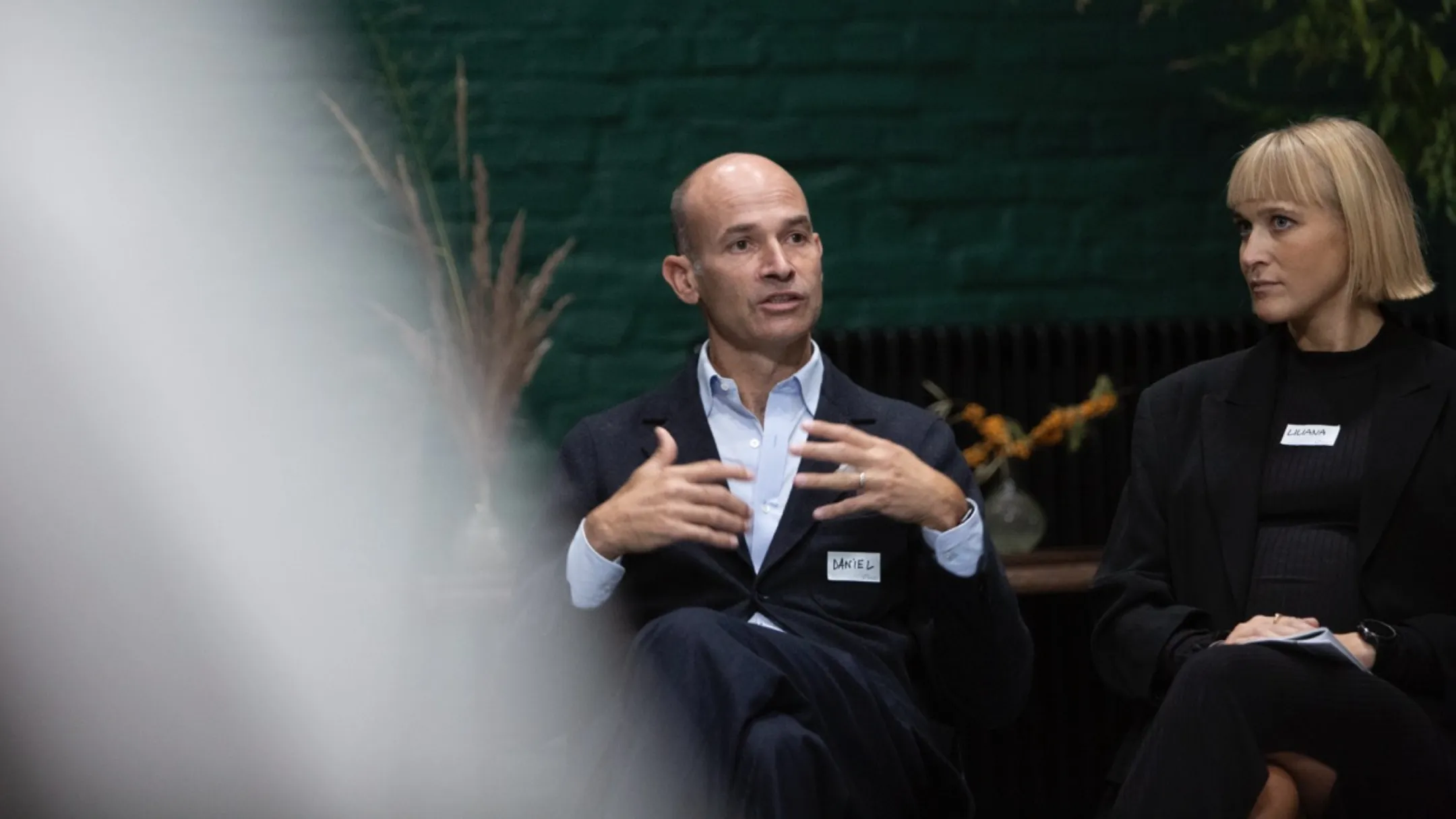
With our partner DW Real Estate, we hosted a day of exploration between AI researchers, innovators, and HR and property leaders.
The question was simple: How should workplaces change as AI becomes part of everyday work, in response to increasingly empty and underused offices?
Read on for our three key learnings.
One of the strongest cross-sector insights came from the real estate perspective: Buildings are slow to change, but human experience can change tomorrow.
In an AI-accelerated world, the biggest leverage point isn’t construction. It's programming. Participants shared how rituals, learning formats, projects, and curated encounters radically changed how space was being used. Long before any physical redesign took place.
For many grappling with return-to-office mandates, this reframed the problem: The most valuable workplaces are those that are actively curated socially, intellectually, and culturally.
AI will help leaders choose the right environment for the task: deep work, innovation, cross-functional problem-solving, or execution.
Try this: Use your office space as a place to convene ecosystems: customers, partners, start-ups, and cross-functional teams. Not just your employees.

AI accelerates tasks. But collaboration, trust, and judgment – the things that actually move organizations forward – still happen between people. As routine work becomes automated, value increasingly emerges from how well humans work together.
That’s why community is no longer a “culture extra.” It’s performance infrastructure. Several participants noted that their biggest productivity bottlenecks weren’t technological, but relational: weak handovers, siloed expertise, and a lack of shared ownership across teams. Where strong internal communities existed, organizations adapted faster. Even under pressure.
Organizations that invest intentionally in community are designing the human system that allows AI-enabled work to actually scale.
Try this: Deliberately design cross-functional communities around real business challenges – not as social initiatives, but as working forums where people solve problems together, learn in motion, and build trust through shared outcomes.
The remote-versus-office debate is a distraction. The real question leaders need to answer is: What kind of work are we trying to enable, and what environment supports it best?
There was broad agreement that deep focus, creative exploration, cross-functional problem-solving, and reliable execution all require different conditions.
Several leaders shared that performance improved not when they mandated presence, but when they became more intentional about matching tasks to environments. Research from JLL reinforces this shift, pointing to growing demand for flexibility, more collaborative and alternative spaces, and deeper integration of technology as AI becomes embedded in daily work.
What’s working now? Treating location as a design variable, rather than enforcing one-size-fits-all policies.


Johanna Fuchs-Boenisch
Global Head of Transaction and Asset Management, Siemens Healthineers
Martin Eyerer
CEO, Green City Development

Andrea Debbane
Chief Sustainability Officer,
Jaguar Land Rover

Denis Klug
CEO, Re:Venue

AI Art Lab
ICAROS

Dr. Felix Böhmer
Director AI & Data Analytics, iteratec GmbH

Rico Schütz
Area Development Manager at Invention & Innovation Management, BMW Group

nera Eco Constructions
Learning
Implementation